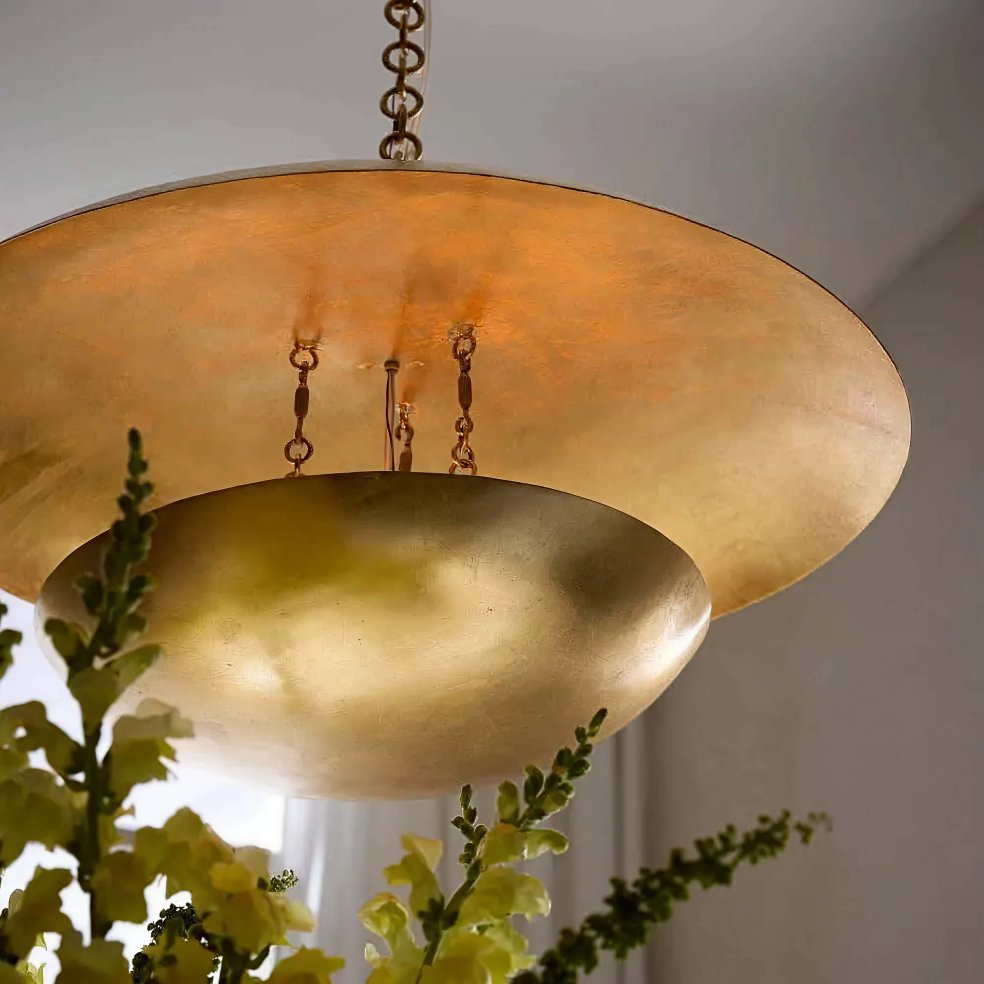
Design & photography: @hickorygrovepictures
Your entryway is your home’s first impression. It sets the tone, signals your sense of style, and shapes how every guest experiences the space before they've stepped further inside. Yet entryway lighting ideas are often treated as a functional checkbox rather than a deliberate design decision. The right light fixture encourages a moment of pause at the entrance and shares a glimpse of your home’s overall design story.
Whether you're working with a dramatic two-story foyer, a compact apartment entry, or a narrow hallway, high-end lighting is the element that makes a transitional space feel as elegant as a main living space. Start by identifying your layout type below, then use the expert guidance that follows to zero in on the fixture and placement approach that best fits your space.
Foyer Lighting Ideas for Every Entryway Layout
Every foyer presents spatial constraints, and the best entryway lighting decisions begin with an honest assessment of what you're working with. Measure your ceiling height, note where your electrical box sits, and take stock of the entry's width and depth before you start shopping. Layout, ceiling height, and square footage each play a role in narrowing down the full range of entryway lighting options.
Small Entryway Lighting Ideas
In a compact entry, scale is pertinent. A fixture that looks beautiful in an airy showroom can overwhelm a small foyer. Aim for visual impact without physical bulk by prioritizing fixtures with interesting silhouettes or distinctive materials rather than large overall dimensions. A single sculptural pendant in smoked glass or a semi-flush mount in patinated brass can carry a small space with the same authority as an oversized chandelier in a grander setting.
To add layered light without claiming square footage, pair your overhead fixture with a slim sconce on either side of a wall mirror. The mirror bounces light back into the room and visually expands the space; a two-for-one move that works in most compact entries.

Project: The Kaleidahaus
Designer: @darbymichelle97
Photographer: @thelaurahenry
Entrance Foyer Lighting for Two-Story Homes
A double-height foyer provides enough vertical clearance to make a statement. Chandeliers with significant drop lengths and visual complexity suit this format well: multi-tiered designs, cascading glass elements, and large-scale sculptural forms hold their presence in a voluminous space.
Before you order anything, consider how the fixture will appear from the upper landing as well as from the front door. Both sightlines matter, and a fixture that only looks good from one vantage will feel underwhelming.
If your foyer has a staircase as a visual anchor, position the chandelier so it descends into the mid-level of the space. This draws the eye upward and reinforces the architecture without competing with it.
Narrow Hallway Entry Lighting
In a long, narrow entry, running a row of ceiling fixtures down the center of the hall can emphasize the corridor's compressed width. Instead, mount wall sconces at regular intervals along one or both sides to create rhythm, add warmth, and pull the eye to the walls rather than the narrow ceiling plane. Spacing sconces roughly every four to five feet results in a cohesive visual cadence without overcrowding the walls.
For a more editorial approach, anchor a single statement pendant at the entry threshold, right where the hallway begins. This move creates a clear focal point and marks the transition from exterior to interior.
Low-Ceiling Entryway Lighting
Because they hug the ceiling, flush mount and semi-flush mount lighting is best for entryways with lower clearance. But sacrificing drop length doesn’t mean you have to sacrifice style: There are excellent options in handblown glass, ceramic, and woven natural fiber that deliver visual presence without requiring vertical clearance. Coordinate the fixture finish with your door hardware or any metal tones already in the space to tie it into the room rather than letting it stand alone.
Apartment Entryway Lighting Inspiration
Since most apartment leases prohibit permanent alterations, oftentimes relocating an electrical box or adding a new ceiling fixture is out of the question. Instead, add depth to your entryway’s existing lighting with table lamps.
Flanking a mirror with wall sconces adds warmth and the light-amplifying effect of the reflection without requiring any permanent installation, while a table lamp on an entry console accomplishes the same layering goal with no mounting required.
To make the layers of light feel cohesive, ensure each source shares at least one design element, whether it be the hardware finish, shade material, or silhouette.
How Lighting Shapes the Mood of an Entryway
Lighting determines not just how clearly we see a space, but how that space feels the moment we step into it. Follow these techniques to shift your entry's mood in the desired direction.
Creating Warmth and Depth
Warm light produces a comforting and welcoming glow, making an entryway feel inviting rather than institutional. Fixtures with linen shades, alabaster diffusers, or seedy glass produce a softened, amber-tinged output that flatters both the space and the people standing in it.
Depth and atmosphere come from layering light sources. Combining overhead lighting with sconces or a lamp on an entry table introduces shadow variation that makes the space feel three-dimensional.

Design: @boydblue
Photography: @roche.interiors.au
Making Small Entryways Feel Larger
Light placement and reflectivity work together to visually expand a small entry. Positioning a fixture to wash light upward toward the ceiling draws the eye in that direction and makes the ceiling feel higher than it is. Placing sconces beside a mirror bounces light around a space, making it feel bigger and brighter.
Polished and reflective surfaces, such as chrome and brass, scatter light across a room more effectively than matte finishes, contributing to a sense of openness even in tight quarters.
Highlighting Architectural Details
An entryway with strong architectural bones deserves lighting that acknowledges them. Picture lights or adjustable sconces direct focused light onto a feature wall, a piece of art, or a sculptural console arrangement. In entries with original molding, wainscoting, or textured plaster walls, grazing light from a wall-mounted source set at a low angle brings out surface texture and dimensionality.
For ceiling details like medallions or coffers, a fixture positioned directly below the detail lets the light work upward into it, so the fixture and the architecture reinforce each other rather than competing with one another.
How Designers Layer Entryway Lighting
Professional designers rarely rely on a single light source in an entryway, and for good reason. Layered lighting serves distinct purposes: ambient light from an overhead fixture sets the overall brightness, accent light from sconces or gallery lights draws attention to specific elements, and task light from table lamps or wall sconces ensures the entry functions for practical needs like finding your keys or checking a mirror before leaving.
Entryway Lighting by Interior Style
The fixtures you choose for the entryway should speak the same visual language as the rest of the home’s interiors. While matching every element precisely is overkill, ensure the entryway fixtures share at least one material, finish, or formal characteristic with other spaces in the home to make the overall design scheme feel cohesive.
Modern Entryway Lighting Ideas
Modern entryway lighting ideas are defined by restraint, precision, and an architectural approach to form. If your entry has clean lines and a restrained palette, reach for geometric pendants in matte black or brushed nickel, linear suspensions with integrated LED sources, or minimalist flush mounts in frosted glass.
In a modern entry, the lighting often functions as the room's element of visual complexity. An opal-glass dome light like the Glaze or a graphic multi-light flush mount like the Axia can carry the design weight that a more ornate space distributes across multiple elements.

Design: @m.lahr_homes
Photos: @ao_fotos
Transitional and Classic Entryway Lighting
If your home sits somewhere between traditional and contemporary, look for fixtures that update a classic silhouette with a modern finish or material. Lantern pendants, candelabra chandeliers, and drum shades work here, but choose them in antique brass rather than polished gold, linen rather than silk, or hand-chiseled steel rather than cast ornament. Take the Griff Chandelier, for example: its edited version of a traditional form reads as timeless rather than period-specific.
Organic Modern and Natural Material Lighting
If your interior emphasizes natural materials such as wood, stone, linen, leather, and clay, your entryway lighting should follow suit. Look for fixtures in rattan, woven fiber, alabaster, or reactive-glazed ceramic for diffused light that provides a warm, environmental feel.
Fixtures in botanical forms and natural patterns work especially well in organic modern spaces. The Kasai Semi-Flush, for example, features clusters of rattan leaves that look like a sculptural art piece
Explore Entryway Fixtures: Pendants, Chandeliers, Sconces, and More
Knowing which fixture type suits your entry before you start shopping will save you time and the headache of returning fixtures that don’t fit. Use this table to find the best fixture type for your distinct entryway.
|
Fixture Type |
Best For |
Ceiling Height |
Key Advantage |
|
Pendant |
Focused entry statement, single drop |
9 ft+ |
Graphic silhouette, scalable |
|
Chandelier |
Two-story foyers, formal entries |
10 ft+ |
Scale, drama, layered light |
|
Flush Mount |
Low ceilings, compact entries |
7–9 ft |
Clearance-friendly, broad range of styles |
|
Semi-Flush Mount |
Mid-height ceilings, transitional spaces |
8–10 ft |
Drop presence without full pendant clearance |
|
Wall Sconce |
Narrow halls, accent and ambient layers |
Any |
Adds warmth, works on any wall |
|
Table Lamp |
Entry console or sideboard vignette |
Any |
Secondary light source, decorative weight |
Entryway Pendant Light Ideas
Pendant lighting works best in entries with ceilings 9 feet high and above. A single pendant’s width should span roughly one-third to one-half the width of the entry, and the bottom of the pendant should hang no lower than 7 feet from the floor in any walkable zone.
Ideal entryway pendant light ideas marry eye-catching shape with a diffused light quality. The Lunaria Pendant features a softly billowed faux vellum shade, bathing an entryway in ethereal light, while its brass ring detailing invites you to do a double take.
Entryway Chandelier Ideas
Installing a statement-making chandelier in a two-story home is an effective way to make a grand entrance. Substantial enough to hold a double-height space and refined enough to set a clear aesthetic tone, the Evers Pendant works beautifully in this context. To choose the right scale, measure the full drop distance from your ceiling to the desired hanging height, then select a fixture whose body fits comfortably within that dimension.
Contemporary chandeliers have expanded well beyond the traditional multi-arm candelabra. An array of linear suspensions, abstract cluster forms, and geometric structures means there's a chandelier-category fixture that works for modern, transitional, and organic modern aesthetics alike.
Entryway Ceiling Light Ideas
The best flush and semi-flush mount lighting fixtures make no apologies for their low-profile format; they treat it as a design opportunity. Handblown glass, ceramic with a reactive glaze, and woven rattan or natural fiber all bring material richness to the ceiling plane in a way that a standard drum shade cannot. Entryway ceiling light ideas with sculptural silhouettes, like the Bilal Flush Mount, add much more visual interest to a space than a basic builder-grade fixture.
Entryway Wall Sconce Ideas
In an entryway, wall sconces add a layer of ambient light at eye level and contribute an artful, finished quality that makes the whole space feel more elevated. A well-chosen pair of sconces flanking a mirror or console signals that the entry was thoughtfully designed rather than simply furnished.
For entryway wall lighting ideas with a jewelry like look, go for pieces that combine an interesting form with metallic finishes. As elegant as a pair of statement earrings, the Elsa Wall Sconce combines organic shape with an elegant gold-leaf frame and light-diffusing onyx.

Design: @twiggandlu_designco
Photo: @mackenzie_merrill
How to Choose the Right Entryway Lighting
Choosing the right fixture among the wide range of front entry lighting ideas is both a technical and intuitive process. The physical parameters of your space (ceiling height, room dimensions, electrical box location, etc.) establish the outer limits. Within those limits, materiality, finish, and form are where the design decisions live. Work through the steps below in order: sizing first, then drop height, then light quality, then coordination with adjacent spaces.
Sizing Your Fixture
Start by adding the room's length and width in feet, then convert that number to inches for an approximate fixture diameter. An 8x10-foot entry suggests a fixture around 18 inches in diameter; a 10x12-foot entry suggests roughly 22 inches. Use this measurement as your floor, not your ceiling; in entries with high ceilings or a strong architectural presence, sizing up a few inches can feel confident rather than overpowering.
For pendant clusters or pairs, calculate the combined visual footprint of all fixtures rather than individual sizes. Two 10-inch pendants hung 12 inches apart read as a 32-inch unit, so assess that collective dimension against the entry's proportions.
Hanging Heights for Pendants and Chandeliers
In a standard 9-foot-ceiling entry, make sure the bottom of the fixture is about 7 feet from the floor. This ensures comfortable clearance for all traffic while keeping the fixture close enough to the human scale of the space for an intimate feel. To calculate drop length: subtract 7 feet (84 inches) from your ceiling height in inches, then subtract the fixture's body height from that number. The remainder is your maximum cord or chain length.
In a two-story foyer, work from both sightlines simultaneously. The chandelier should clear 7 feet at the floor level, ideally read at eye level from the upper landing, and still have enough visual mass to register across the full vertical distance. If your ceiling box sits off-center from the ideal hanging position, a swag kit lets you route the cord from the box to a ceiling hook positioned directly above the entry.
Brightness and Color Temperature
Select bulbs or integrated LEDs in the 2700K to 3000K color temperature range for your entryway. This produces warm, welcoming white light that avoids tipping into the orange tones of very low-kelvin sources. For entries used heavily during daylight hours, the warmer end of 2700K pairs especially well with natural light, since they don't fight each other the way cool and warm sources can. And to adjust brightness throughout the day, install a dimmer switch.
Coordinating Indoor and Outdoor Entry Fixtures
Stand at your front door and look inward, then turn around and look outward. The fixtures on both sides of that threshold should feel like they belong to the same conversation. When exterior and interior fixtures share a finish, the transition will feel more fluid.
Scale matters in this coordination as well. If your outdoor lighting scheme includes a large exterior lantern, the interior fixture should be proportionally substantial. A large exterior piece paired with a small interior pendant creates a visual discontinuity at the threshold.
Common Entryway Lighting Mistakes to Avoid
Hanging a fixture too high is the most common and most correctable error. A chandelier or pendant that hovers at ceiling height provides ambient light but looks disconnected from the human scale of the space. Confirm your drop length before installation and lower the fixture if needed.
Undersizing is equally problematic. A fixture that's too small for its entry feels like an afterthought. Err toward the upper end of the sizing formula range, particularly in entries with high ceilings or strong architectural presence.
Skipping a dimmer switch limits the entry to one lighting register for every use case. Since the entry needs to both function well and leave a positive impression, a dimmer is the single highest-value addition to any entryway lighting plan.
Relying on a single overhead source leaves the edges of the space in shadow and the room feeling unfinished. Adding a table lamp on a console or a pair of sconces on the wall completes the layered effect that makes a space feel designed rather than simply lit.
Make Entryway Lighting Part of the Design Story
The entryway is where people form their first impression of your home, and much of that impression is shaped by the room’s lighting scheme. Entryway lighting sets the tone for the home’s interior rooms and tells guests what kind of space they've walked into. Done well, entryway lighting doesn't just welcome guests; it introduces the design language of the whole interior.
One of the key luxury home lighting ideas is to carry similar finishes and materials throughout each room to make the home feel like a cohesive whole rather than a collection of separate decisions. Using entryway lighting to create a warm and inviting arrival moment instantly puts you and your guests at ease; carrying that feeling throughout each space helps convey your home’s singular design story.

Design: @silverwinginteriors
Frequently Asked Questions About Entryway Lighting
What Is the Best Type of Light for an Entryway?
The best fixture depends on the specific dimensions and style of your space. When in doubt, refer back to the layout and ceiling height guidance above before settling on a fixture category.
Do You Need a Chandelier in a Small Entryway?
A chandelier can work in a small entry if the ceiling height allows. When it doesn't, a sculptural semi-flush mount or a pendant delivers the same visual impact at a smaller scale.
Can You Mix Entryway Lighting Styles?
Yes, provided the fixtures share at least one material, finish, or formal element. A unified finish across different fixture types is the most reliable way to make mixed styles feel cohesive.
Should Entryway Lighting Match the Rest of the House?
Matching finishes throughout creates continuity, but exact replication isn't required. A dominant finish in the entry that carries through to adjacent spaces creates a sense of flow without demanding uniformity.