The most social piece of furniture in your home, the dining table hosts celebrations, anchors evening routines, and serves as a gathering point for the people who matter most. Knowing how to choose a dining table that functions beautifully and holds its own aesthetically requires more than measuring the room and picking an attractive finish. To find the right fit, one must account for scale, proportion, material integrity, and longevity. This dining table buying guide walks you through every step of that process, from initial measurements to final styling decisions.
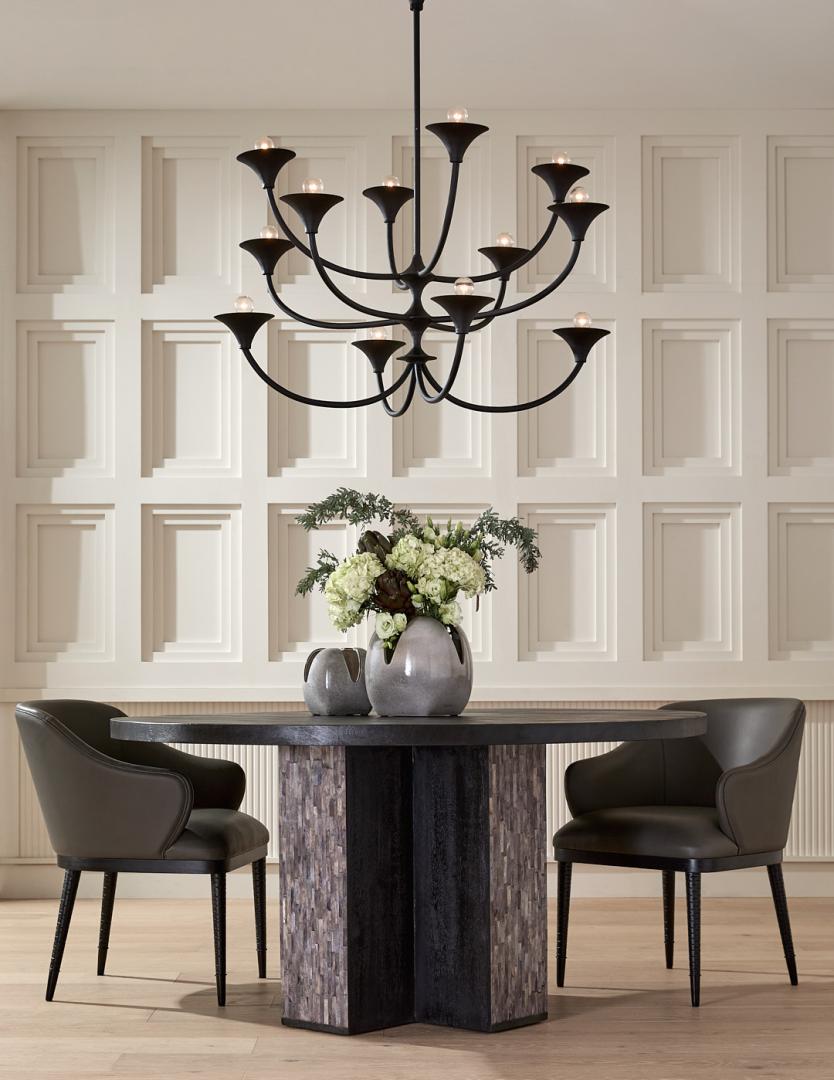
A Designer’s Step-by-Step Guide to Choosing a Dining Table
Overwhelmed by the endless supply of available dining table options? Follow these five steps to hone in on the table type that’s right for your space and style.
Step 1: Start With Space, Flow, & Function
Every table decision begins with an honest assessment of your room. How large is the space? Where are the entry points? How does traffic move through the room? These answers will determine your table’s maximum footprint.
A dining room that doubles as a passageway to the kitchen demands more generous clearance around the table than a dedicated formal dining room with a single entry. A breakfast nook with built-in banquette seating requires different spatial logic than an open-plan living and dining area. To decide the table shape and size that will work best, you must first determine how the space is used.
Step 2: Define Seating Capacity & Scale
Resist the impulse to seat as many people as possible, as overcrowding a table to squeeze in two extra dining chairs sacrifices comfort and flow. The right table offers a comfortable amount of space for those who regularly use it, with the ability to add a few more seats for occasional hosting.
Scale, however, goes beyond the headcount. In a voluminous space with ample square footage and a high ceiling, a substantial table grounds the room. In a more intimate space, prioritize functionality by choosing a smaller table that leaves enough clearance for chairs to be scooted in and out.
Step 3: Select a Shape That Supports the Room
To create visual harmony, allow the shape of the room to influence the shape of the table. For instance, a long rectangular room calls for a table that follows its axis, while a proportionate square room invites a round or square table. A table’s shape also governs traffic flow, sightlines, and social dynamics at the table. Round and square tables encourage intimate conversation, while rectangular tables create natural head positions and work well for more formal, social occasions.
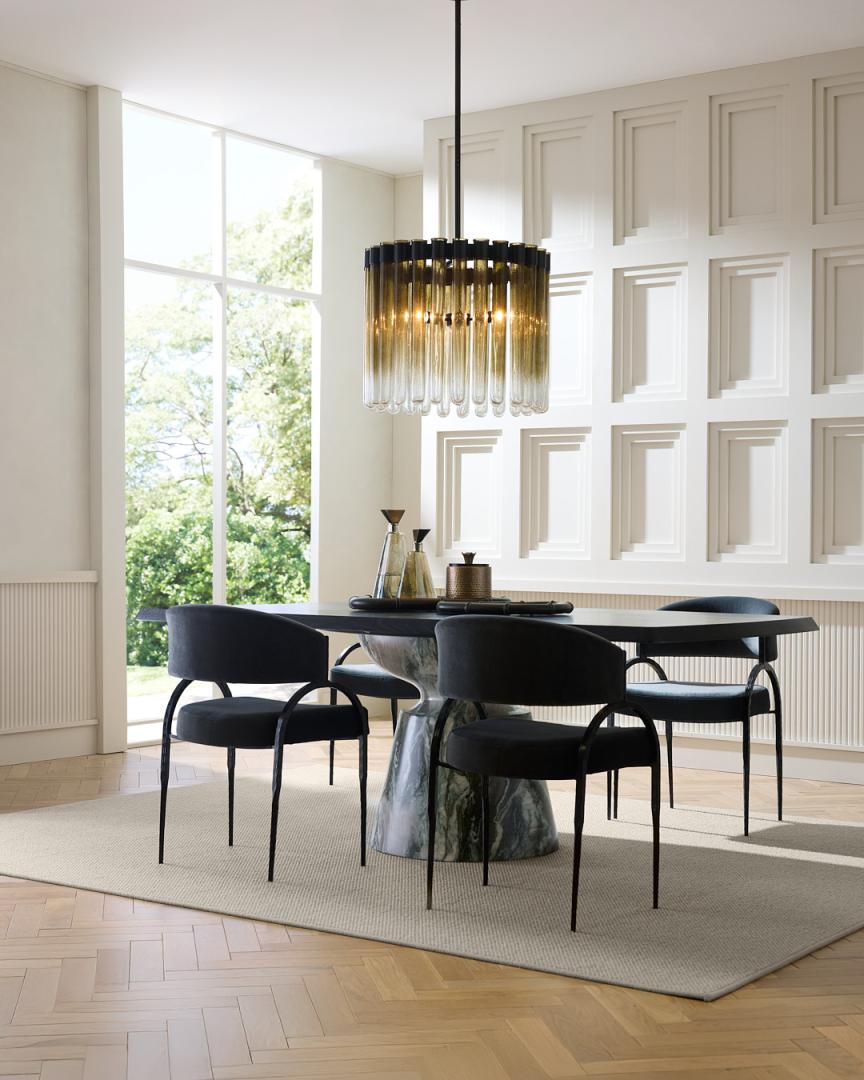
Step 4: Choose Materials That Reflect Your Lifestyle
Before deciding on your dream dining table, ask yourself: How will we actually use this? A table used by young children or for three meals a day benefits from surfaces that age well and clean easily, while a table used primarily for formal occasions can accommodate more precious materials. For a warm, lived-in look, solid woods and wood veneers tend to show wear and character over time. When properly cared for, stone, concrete, and glass tops stand up to scratches and can be easily wiped down.
Step 5: Refine the Table Through Proportion & Detail
Once shape, scale, and material are in place, proportion and detail become the finishing work. Consider what draws you in when you encounter a table you love: Is it the silhouette of the base, the way a turned leg carries a sense of craft and history, or the clean confidence of a marble slab top? These details are expressions of the table’s personality and your style preferences.
The Technical Foundation: Measuring for Flow & Function
Good proportions begin with accurate measurements. These practical specifications ensure your table functions as well as it looks.
Define Your Dining Space Function
In open-plan environments where the dining area flows into living and kitchen zones, the table often serves as a spatial anchor that defines the dining area without physical walls. Its placement, orientation, and scale all contribute to how legible the room's zones feel. Placing a dining table on a rug that is properly sized for its footprint is one of the clearest ways to define that zone and give the table visual grounding.
Calculate the Ideal Table Footprint
The standard clearance guideline is 36 inches between the edge of the table and the nearest wall or furniture pieces, which allows a chair to be pushed back or a person to walk behind a seated guest without interrupting conversation.
To calculate your maximum table length and width, measure the room dimensions, subtract the clearance on all sides, and work within what remains. If the resulting footprint feels too small to seat the number of guests you need, consider a table with an extension leaf rather than pushing the size beyond what the room can comfortably accommodate.
The Golden Rules of Scale: Height, Width, & Proportion
Height, width, and proportion each affect how a dining table functions within a space. A table’s height should account for the seating’s dimensions and vice versa—mismatched pairings can result in uncomfortable and awkward eating positions. Width shapes the experience of sitting at a table, where narrower surfaces create intimacy and wider ones allow for generous place settings and centerpiece styling. Proportion ties both together and decides the table’s visual presence within a space.
Size & Capacity: Choosing the Right Fit
Use the following dimensions and configurations as a practical reference for the most common dining room scenarios.
Standard Table Dimensions by Shape
These ranges can be used as a starting guideline, reflecting what is most widely available. Custom pieces can extend in both directions.
|
Shape |
Common Sizes |
Typical Seating |
|
Rectangular |
60–96 in L × 36–42 in W |
6–10 |
|
Round |
36–72 in diameter |
4–8 |
|
Square |
36–54 in per side |
4–8 |
|
Oval |
60–84 in L × 36–42 in W |
6–8 |
How Much Space Each Guest Needs
The minimum per-seat allowance is 24 inches of linear table edge. At that spacing, guests can dine comfortably without feeling crowded. Generous settings allocate 28 to 30 inches per guest, which allows space for full place settings, glassware, and elbow room.
Working from these allowances:
-
A 60-inch rectangular table comfortably seats 6 (1 at each end, 2 per side)
-
A 72-inch rectangular table seats 6 to 8
-
A 96-inch rectangular table seats 8 to 10
-
A 48-inch round table seats 4 to 5
-
A 60-inch round table seats 6 to 7
Leg Room & Pedestal Bases
Four-corner legs create fixed seating positions: guests seated at corners or at the head of the table may find the legs interfere with their knee placement. A pedestal or trestle base eliminates this issue, offering full leg clearance along the entire perimeter.
For round tables in particular, a central pedestal base is often the most functional solution because it allows any number of guests to position themselves freely around the surface without navigating a leg. For rectangular tables with four or six legs, confirm the inner leg spacing before ordering, especially if you intend to seat guests at the table's corners.
Extendable Dining Tables for Versatile Luxury Hosting
An extension table is one of the more pragmatic investments in a dining room, particularly in homes that host large gatherings a few times a year but do not have the space for an oversized table daily. High-quality extension mechanisms have evolved in recent years, and the best versions are smooth, easy to operate, and nearly invisible when extended.
Selecting a Shape to Optimize Your Layout
The shape of a dining table influences the flow of the room, the quality of conversation, and how the space feels at scale. Understanding what each form offers makes it easier to match a table to both the dimensions of the room and the way you intend to use it.
Rectangular Tables for Larger Spaces
In a voluminous dining room or open-plan space, a rectangular table provides a grounding effect. Its extended form gives large spaces a sense of purpose and visual weight, creating a focal point that the rest of the room can organize around. Where other shapes might feel adrift in a large-scale setting, a substantial rectangular table holds the space with authority.
Round Tables for Flow & Conversation
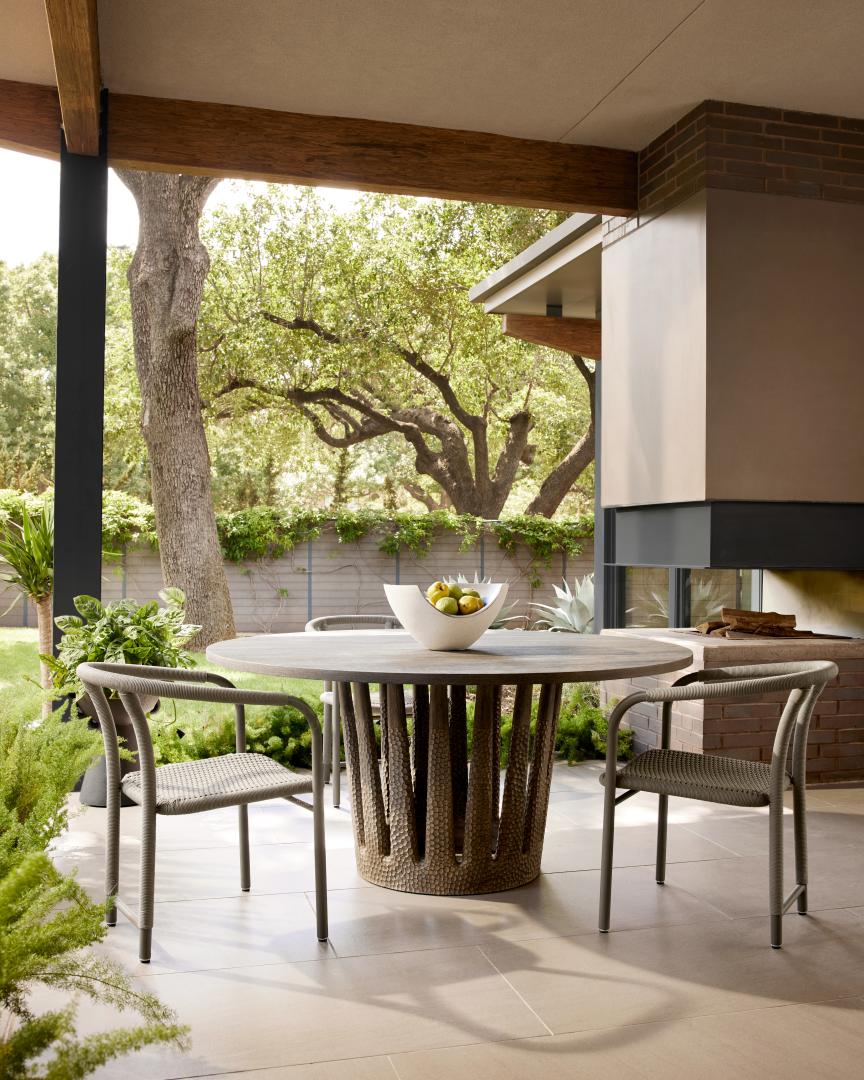
The round table has a democratic quality to it: everyone is equally positioned relative to the center, which makes conversation feel more circular and inclusive. There is no head of the table, no peripheral seat that feels marginal, and no long diagonal to shout across.
From a spatial perspective, round tables are easier to circulate because they eliminate corners. In a room with limited clearance, the absence of corners can make a meaningful difference in how freely guests and hosts move around the space.
Square & Oval Table Options
A square table works exceptionally well in a square dining room, creating a satisfying geometric correspondence between furniture and architecture. It seats 4 people at maximum intimacy, making it a natural choice for smaller households or breakfast rooms where the scale of a rectangular table would feel excessive.
The oval table offers a middle path between rectangular and round. It carries the length and seating capacity of a rectangular table while introducing the softer perimeter geometry of a round one. In rooms where you want generous seating without hard corners, and where the visual weight of a rectangular edge feels too rigorous, an oval is often the most elegant solution.
Materiality & Integrity: The Arteriors Standard of Quality
Every Arteriors dining table begins with a question: What materials and methods will make this piece worth keeping for a lifetime? That commitment to intentional design is what separates a well-made table from a future heirloom.
Construction Quality in Wood, Stone, & Metals
Arteriors dining tables are built from high-quality materials chosen for both their visual character and their capacity to endure. Solid wood develops warmth and individuality over time, with grain variation that ensures no two pieces are exactly alike. Stone and iron provide a grounded, weighty presence, and brass-finished metals and hand-applied patinas add dimension and depth.

Designer-Led Collections: Art Meets Utility
Arteriors’ dining table collection is a dialogue between art and craft. Featuring sculptural silhouettes and distinctive details, each piece makes a statement while serving its utilitarian purpose.
Why 35 Years of Artisan Expertise Matters
Arteriors has spent over 35 years developing relationships with artisan workshops around the world. With a commitment to preserving artisan traditions and sourcing responsible materials for all of our furniture and lighting, Arteriors focuses on intentional design that withstands time.
Built for Longevity & Sustainability
True sustainability means building products that last. Every piece in the Arteriors collection is rigorously tested to global safety and performance standards, using responsibly sourced materials including FSC-certified woods. A dining table that holds its quality and character across decades is one of the more meaningful investments a home can hold, and one of the most honest ways to honor the resources that went into making it.
Design-Led Dining Table Use Cases
Different living situations call for different approaches to the dining table. These use cases provide context for how specific material and design priorities apply to real-world scenarios.
Hospitality-Inspired Dining at Home
For hosts who entertain frequently and want the dining room to feel like a destination, the table becomes a stage. The scale is generous, the materials are impressive, and the overall composition of the room—from the table to the dining chairs to the lighting overhead—is seen as a single entity.
To create an entertaining-ready environment, choose a statement table anchored by a substantial base, topped with a material that commands attention, and scaled to seat 10 or more.
Performance Materials for Busy Homes
A dining room used for frequent family meals or as a workspace benefits from hard-wearing surfaces built to withstand real-world contact. Durable wood veneers and easy-to-clean concrete composite materials stand up to wear and tear without sacrificing aesthetics.
Statement Tables for Open Plans
In an open-plan living space where the dining table is visible from the kitchen and living room, the table defines the room. Choosing a table with a distinctive silhouette, a sculptural base, or a top in a material that’s visually intriguing from a distance is particularly important in these situations. A piece that only reveals its quality up close loses most of its impact in an open-plan context.
Matching Finishes With Lighting and Art
The table exists in a relationship with the dining room lighting and furniture that surround it. To establish a clear material hierarchy in a space, one dominant material should be echoed in subtle ways throughout the room. For example, a warm-toned walnut dining table pairs naturally with antique brass hardware, while a cool-toned stone top leans toward brushed nickel, polished chrome, or blackened iron.
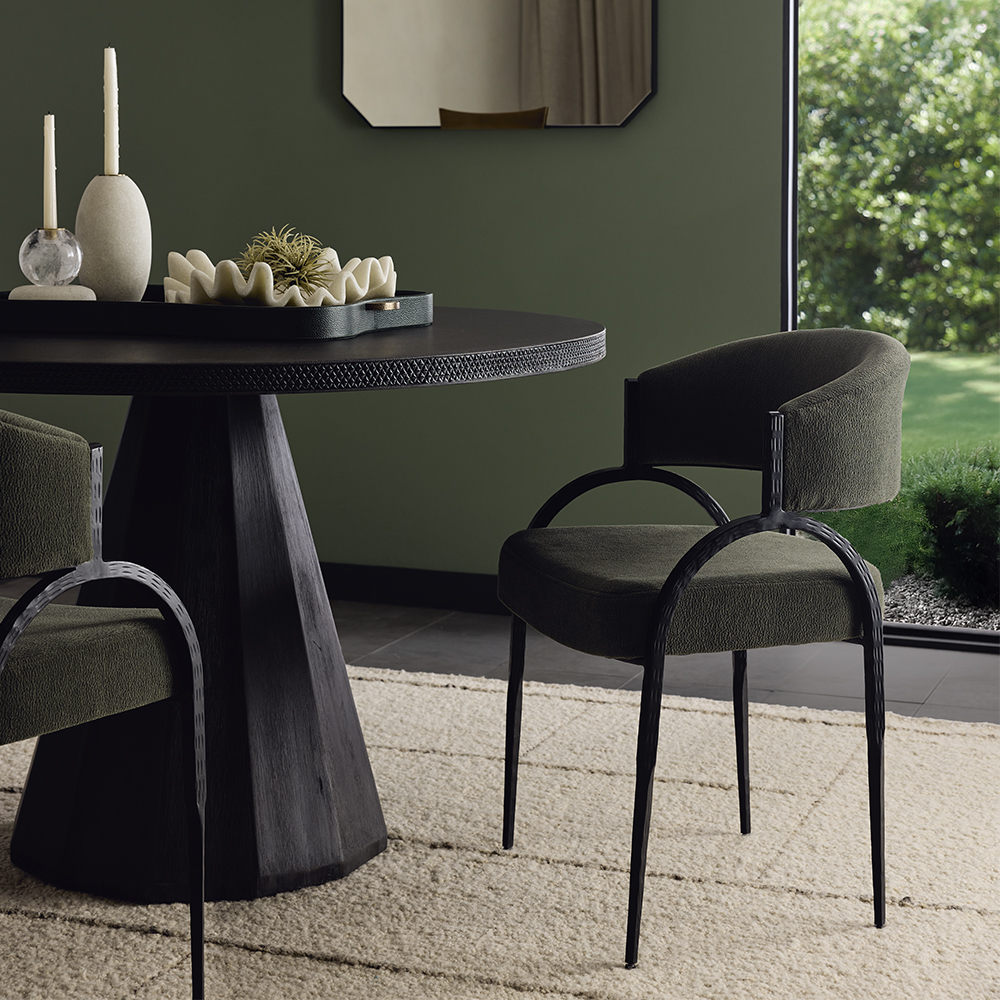
5 Common Dining Table Buying Mistakes
Even experienced designers make avoidable errors in the dining table selection process. Here are the five most consequential ones.
1. Overlooking Proper Clearance & "Push-Back" Space
The most common mistake in the dining table buying process is sizing the table to fill the room rather than sizing it to function within the room. A table that looks proportionally correct in a floor plan can make a room feel cramped in person once chairs are pulled out and guests are moving around it. Measure for push-back space first: 36 inches on every side is the standard; 30 inches is the minimum.
2. Choosing Style Over Durability
A table that looks extraordinary in a showroom but is finished in a material that cannot withstand regular use becomes a source of ongoing frustration. Before committing to a surface, ask directly about its maintenance requirements and vulnerability to heat, moisture, and impact.
3. Misjudging Scale & Visual Balance
A table that is technically within a room's clearance dimensions can still feel visually wrong if its scale is mismatched with the rest of the room's furnishings. A visually heavy table in a light-filled room with slender furniture may read as imposing rather than grounded, while a delicate table in a room with substantial architectural details may read as tentative. Scale is relational, and the table needs to hold its own within the full composition.
4. Forgetting to Measure Entryways & Door Frames
Before ordering a large rectangular table or any piece with a substantial stone top, confirm that it can navigate entry points, stairwells, and hallway turns. For large pieces, some manufacturers offer assembly options where the top and base are installed separately.
5. Ignoring the Visual Weight of the Table Silhouette
Visual weight is a perceptual quality that affects how the table reads in the room and how it relates to the ceiling height, the window-to-wall ratio, and the furniture surrounding it. A low-ceilinged room benefits from a lighter visual profile, while a double-height space can carry a more substantial silhouette.
The Dining Table Checklist: Final Steps Before Ordering
Before finalizing any purchase, work through this checklist to confirm that every decision has been considered.
Step 1: Verify Dimensions & Clearance
Confirm the table's length, width, and height against your room measurements. Verify clearance on all sides with chairs in place. If you are ordering chairs separately, confirm that the seat height is compatible with the table height before ordering both.
Step 2: Confirm Finish Care Requirements
Every finish has a specific care protocol. Understand what cleaners are safe to use, whether the surface is heat-resistant, how it responds to moisture, and what the long-term maintenance expectation is.
Step 3: Evaluate Longevity & Warranty
A well-constructed luxury dining table should carry a meaningful warranty and be built with materials and joinery that support long-term use.
Step 4: Check Harmony With Lighting & Décor
Before ordering, mentally place the table in its room. Does the finish relate to the metalwork in your chandelier? Does the top material have a temperature (warm, cool, neutral) that harmonizes with the surrounding palette? Does the base geometry echo or intentionally contrast with the room's dominant lines? These considerations will help you determine if a piece is a material match for your existing design elements.
Step 5: Confirm Delivery & Access
To ensure the piece will arrive within your project timeline, confirm the delivery estimate and assess whether the table can enter your space. For white-glove delivery, confirm what the service includes: whether delivery personnel will place the piece and remove packaging, and whether any assembly is required on site.
When to Invest: Sales Cycles & New Collection Launches
For buyers who want to time a purchase strategically, understanding the seasonal rhythms of the luxury furniture market is a useful advantage.
When Designer Collaborations Are Worth It
Collaborative collections between furniture brands and independent designers often produce pieces with a strong creative vision and artistry. While these statement-making pieces can transform a room, collaborative collections are often produced in limited quantities with longer lead times than core catalogue pieces. Factor timing and availability into your planning if a collaborative piece is at the top of your list.
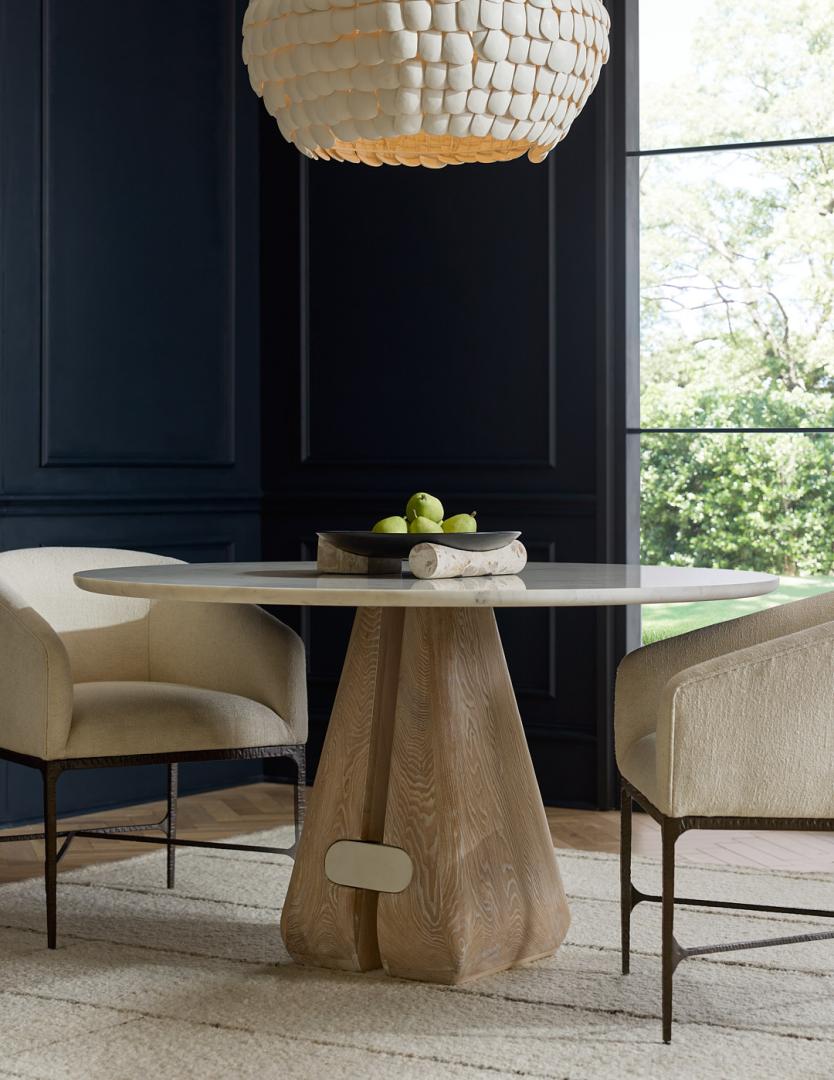
The Melt Dining Table by Workshop/APD
Final Thoughts: Choosing for Longevity
Knowing how to choose a dining room table is ultimately about choosing for the long term. The right table is sized for the room, constructed to last, finished in a material that suits the way you actually live, and designed with enough integrity that it holds its relevance as other things in the room change around it. It is a piece that rewards the investment of time made in selecting it.
The decisions outlined in this guide, from measuring for clearance to evaluating base geometry to understanding material maintenance, exist to narrow a wide field of options down to the few that are genuinely right for your space and your life. When you find that piece, the choice becomes easy.
Frequently Asked Questions
How Much Clearance Is Needed Behind Chairs?
Allow at least 36 inches between the table edge and the nearest wall or furniture, with 30 inches as an absolute minimum for chairs to push back and guests to pass comfortably.
How Do I Choose the Correct Rug Size?
The rug should extend at least 24 inches beyond the table on all sides, ensuring chair legs remain on the rug even when pulled out. For a 72-inch rectangular table, a 9×12-foot rug is a reliable starting point.
Which Base Style Is Best for Seating?
Pedestal and trestle bases offer the most flexible seating because they eliminate leg interference at corners. Four-leg bases fix seating positions more rigidly.
How Do I Care for Artisan Finishes?
Use pH-neutral cleaners and avoid abrasive materials. For hand-applied and reactive finishes, follow manufacturer-specific guidelines, as cleaning protocols vary significantly by material and finish type.
How Do I Mix Different Chair & Table Styles?
Establish consistency in one element, whether finish, material, or silhouette, while allowing variation in others. A consistent metal tone across table and chair hardware, for example, unifies the varied elements.