Design: @fordesign.studio
Photo: @lomillerphoto
Once synonymous with tiered crystal arms and formal dining rooms, designer chandeliers have evolved into one of the most diverse fixture categories in interior design. Today, there are types of chandeliers for every aesthetic preference and every room, and choosing the right one requires an understanding of which form suits your space, your ceiling, and the atmosphere you want to create.
What Are the Different Types of Chandeliers?
While related, chandelier types and styles are two distinct categories. A type describes the physical form and construction of the fixture (i.e. its shape, the way it holds light, and how it's built).
A style describes the aesthetic language the fixture speaks: traditional, modern, organic, and so on. Use this table to navigate how the two categories interact.
|
Chandelier Type |
Primary Form |
Common Styles |
Best Room Applications |
|
Crystal |
Tiered arms with hanging crystals |
Traditional, Glam |
Dining room, entryway, ballroom |
|
Candelabra |
Branching arms with candle-style sockets |
Traditional, Transitional |
Dining room, living room |
|
Drum |
Cylindrical fabric or metal shade |
Transitional, Modern |
Dining room, bedroom |
|
Lantern |
Enclosed geometric cage |
Traditional, Industrial |
Entryway, stairwell, kitchen |
|
Sputnik |
Radiating rods with exposed bulbs |
Mid-Century, Modern |
Living room, dining room |
|
Linear |
Horizontal suspension over elongated surface |
Modern, Transitional |
Dining room, kitchen island |
|
Tiered |
Stacked descending rings or layers |
Traditional, Glam, Coastal |
Dining room, entryway |
|
Orb |
Spherical open or closed frame |
Modern, Industrial, Organic |
Living room, bedroom |
Popular Chandelier Types by Shape, Form, and Detail
The different types of chandeliers each have a distinct way of holding, diffusing, or directing light, and a particular visual weight it brings to a room. Here's how to identify and evaluate the most common types.
Crystal Chandeliers
Crystal chandeliers are defined by their light-refracting material: faceted crystals, glass drops, or prisms hung in layered formations that scatter light across a room. The traditional version features tiered arms draped in strands of cut crysta, while contemporary interpretations (like the Berkley Multi-Drop Chandelier) may use smoked, colored, or geometric crystal forms in sparser arrangements.
Candelabra Chandeliers
The candelabra is among the oldest chandelier forms, modeled after the candlestick arrays that lit formal rooms before electricity. Today's versions retain the branching arm structure and candle-style sockets but are available in a wide range of finishes and silhouette complexities.
Candelabra chandeliers, like the Griff Chandelier, work especially well in rooms with strong architectural bones, such as coffered ceilings, wainscoting, or substantial millwork.

Design by @nicholascarldesign
Photography by @nativehousephotography
Drum Chandeliers
The drum is defined by its cylindrical shade, which encases the light source and diffuses illumination evenly downward and outward. Fabric shades in linen or cotton produce a warm, soft glow; metal or glass drum shades shift the effect toward something crisper. The silhouette is low-profile and quietly contemporary, which makes it one of the more versatile types across style categories.
Drum chandeliers can feature a single drum or a tiered silhouette, as seen in the Hecche Chandelier. Compact drum shades work in bedrooms and breakfast nooks, while oversized versions make a strong statement in larger dining rooms.
Lantern Chandeliers
Lantern chandeliers enclose their light source in a geometric cage, typically square or hexagonal, often with glass panels framed in iron, brass, or bronze. The effect is architectural and contained, in contrast to the open, radiating silhouettes of candelabra or sputnik forms.
Traditional lantern chandeliers are associated with entryways, stairwells, and covered outdoor spaces; contemporary versions in blackened iron or aged brass translate well into kitchen and dining contexts.
The enclosed form, as seen in the Trenton Linear Chandelier, makes a lantern chandelier particularly suited to spaces where you want to add visual structure without a heavy silhouette.
Sputnik Chandeliers
Named for the satellite that sparked the space age, sputnik chandeliers radiate outward from a central sphere, with individual rods terminating in exposed bulbs or small shades. The form is inherently mid century modern, with starburst geometry that speaks directly to 1950s and 1960s design, yet it also works well in contemporary spaces.
The radiating structure provides a wide visual footprint without a heavy mass, making sputnik-inspired fixtures, like the Celeste Chandelier, well-suited to rooms with moderate ceiling heights where a tiered or cascading fixture would feel too weighty.
Linear Chandeliers
A natural choice above rectangular dining tables, kitchen islands, and elongated living room arrangements, linear chandeliers run horizontally rather than radiating from a central point. The form echoes the geometry of the surface below, reinforcing visual continuity in the room.
Arteriors' linear chandelier collection includes a range of interpretations, from clean steel frames with glass globes to leather-wrapped structures with organic material detail.

Design: @lizmearns Imagine Design
Photo: @christykosnic
Tiered Chandeliers
Tiered chandeliers stack descending rings, layers, or cascading elements to build vertical presence and visual complexity. The form has a grand appearance and works best in spaces with ample ceiling height, such as two-story entryways, formal dining rooms, and open living spaces.
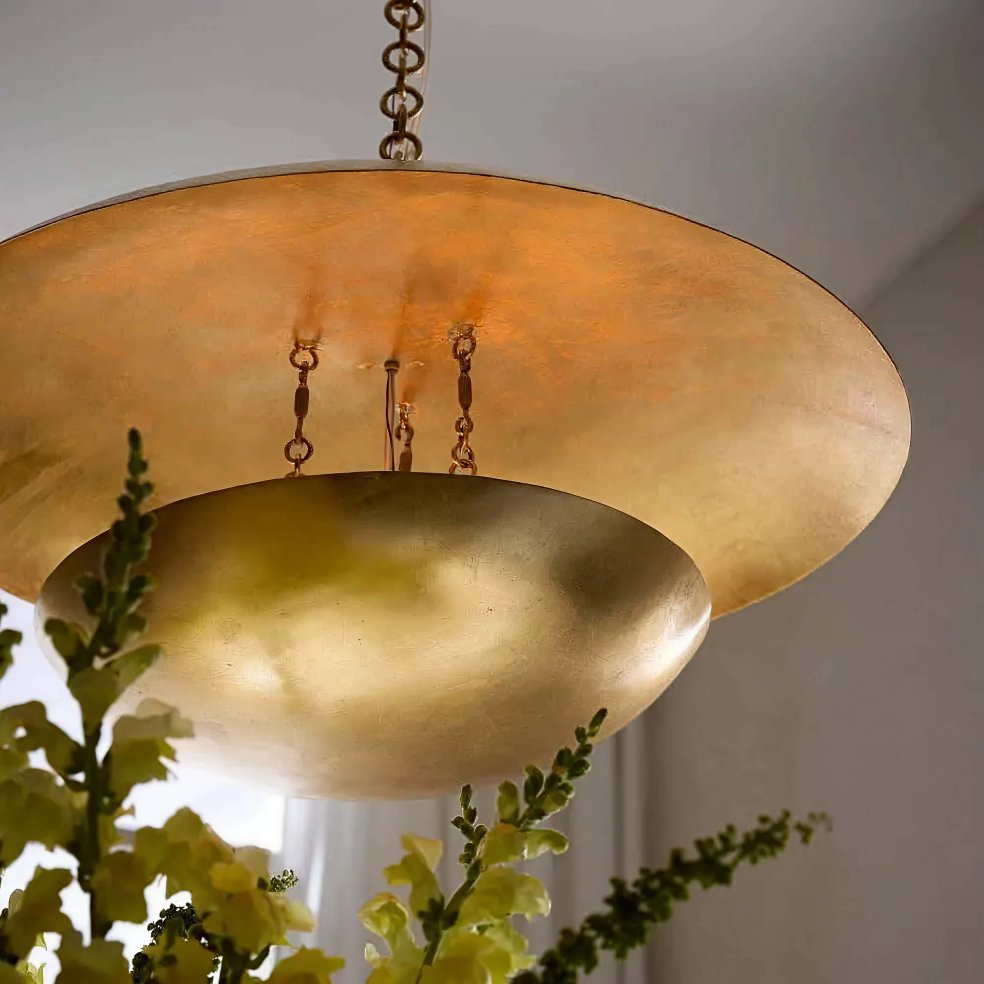
From traditional crystal to contemporary gold-leafed iron (as seen in the Prescott Two-Tiered Chandelier), material variation is wide within the tiered category. The layered structure also affects light distribution, as each tier adds to the diffusion and creates a more enveloping ambient glow than a single-plane fixture.

Design by @caseygeebinteriordesign
Photography by @heysaraprince
Orb Chandeliers
Orb chandeliers take a spherical form, either as an open wire frame or a more solid enclosed globe. The shape is inherently balanced and graphic, which gives it versatility across aesthetics.
Because the orb form is visually self-contained, it works well in rooms where you want a clear focal point and even illumination. The Baptiste Chandelier, for example, balances sculptural structure with sophisticated restraint.
Chandelier Styles Explained
To determine a chandelier’s style category, look at its finishes, materials, and form. Understanding style helps you choose a fixture that speaks the same visual language as the rest of your interior.
Traditional Chandeliers
Traditional chandeliers draw from European historical precedents with their formal symmetry, ornate detailing, crystal or candlelight sources, and finishes in polished brass, bronze, or antiqued gold. They suit spaces with classical architectural details including crown molding, coffered ceilings, paneled walls, and formal furniture arrangements.
The key with traditional fixtures in a contemporary context is practicing restraint, or choosing a version where the historical reference is legible but not overwhelming, as seen in the Larie Chandelier.
Modern Chandeliers
Modern chandeliers prioritize geometry, material honesty, and the absence of decorative excess. Clean steel frames, frosted or smoked glass, matte black or brushed nickel finishes, and structured silhouettes define the category.
Modern chandeliers often have a strong or eye-catching structural silhouette, like the Brutalist-inspired Waylon Chandelier.
Transitional Chandeliers
Transitional style occupies the territory between traditional and modern, which makes it one of the most broadly applicable aesthetic categories. Transitional chandeliers typically feature classic forms (drum shades, branching arms, tiered structures) reinterpreted in cleaner proportions and finishes that read as warm but not ornate. Antique brass, warm bronze, and soft linen are the materials of choice.
For example, the Luciano Chandelier would feel at home in a wide range of interiors, from updated traditional to relaxed contemporary.
Mid-Century Chandeliers
Mid-century modern chandeliers borrow from the postwar design movement's characteristic optimism and geometric clarity. Sputnik and starburst silhouettes, brass and walnut material combinations, and exposed bulb configurations are the hallmarks. The style carries a particular warmth; it’s modernist in its geometric logic but inviting in its material palette.
Mid-century chandeliers, including the Zanadoo Fixed Chandelier, work well in spaces with warm wood tones, leather, and textured textiles.
Organic Modern Chandeliers
Organic modern style is inspired by shapes and materials derived from nature. Woven rattan, raw wood, hand-shaped iron, and ceramic components characterize the category. Light moves through and around these fixtures in a way that feels textured rather than precise.
Arteriors' natural chandelier collection captures this sensibility through fixtures that use woven fiber, organic branch forms, and hand-applied finishes to bring material depth and warmth to a space.
Organic modern chandeliers work particularly well in rooms that balance clean architecture with natural material accents.
Sculptural Chandeliers
Sculptural chandeliers are defined by asymmetrical forms, unexpected material combinations, hand-fabricated components, and compositions that read differently from every angle. These fixtures function as the room's primary design gesture, and they work best in a room with simpler furniture, quieter surfaces, and a pared-back color palette.
The oversized chandelier collection at Arteriors includes several fixtures of this type, scaled to make their full presence felt in rooms with generous space and ceiling height.

Design by @greyhouseint
How to Choose the Right Chandelier for Each Room
Different rooms make different functional and aesthetic demands on a chandelier. Use the table below as a quick reference guide for choosing the best chandelier type for your specific room.
|
Room |
Recommended Types |
Finish Direction |
Key Sizing Consideration |
|
Dining Room |
Linear, candelabra, tiered |
Antique brass, bronze, warm metals |
2/3 of table length; hang 30–36" above tabletop |
|
Living Room |
Orb, sculptural, sputnik |
Mixed metals, matte black, aged finishes |
Center over seating, not room midpoint |
|
Entryway |
Tiered, lantern, oversized |
Statement finishes, high polish or aged iron |
7 ft. min. floor clearance; scale to ceiling height |
|
Bedroom |
Drum, orb, low-profile decorative |
Soft metals, linen, warm glass |
Lower lumen output; center over bed or room |
|
Kitchen Island |
Linear, pendant-style |
Practical finishes; unlacquered brass, iron |
Match island length; 30–36" above countertop |
Dining Room Chandeliers
The dining room is the natural home of the chandelier, where the fixture anchors the table and sets the tone for every meal and gathering that happens around it.
Linear chandeliers are the strongest functional choice above a rectangular table, echoing its geometry and distributing light evenly along its length. For round tables, a radial form (candelabra, tiered, or orb) creates visual continuity between the surface and the fixture.
Often the focal point of the dining room, the chandelier should be big enough to hold the scene but leave enough visual space for cross-table conversation.
Living Room Chandeliers
A chandelier in the living room draws the eye upward and gives the seating arrangement a vertical anchor. Sculptural, sputnik, and orb forms tend to work well here because their graphic silhouettes read clearly from a distance and hold their visual weight across a larger field of view.
In open-plan spaces, an oversized chandelier can serve as an architectural boundary between the living and dining zones.
Entryway Chandeliers
The entryway creates a home’s first impression, so it benefits from a chandelier that makes a statement. The vertical drop of tiered forms and lantern chandeliers work well in a double-height entry, while sculptural and oversized fixtures set the tone for a contemporary home.
Allow the room’s ceiling height to guide the scale, as a modest fixture in a tall entry will feel lost, while a generous fixture in a lower entry will feel imposing.

Design by @fourstoryinteriors
Photography by @laurasumrak @julajoules
Bedroom Chandeliers
The best bedroom chandeliers contribute to the relaxed atmosphere without demanding attention. Fixtures with quieter forms and light-diffusing materials work well in this sanctuary-like space. Low-profile drum chandeliers, decorative chandeliers in natural materials, and smaller orb forms can add a sculptural quality without too much visual weight.
Kitchen Island Chandeliers
A single chandelier is a bold alternative for a grouping of pendant lights above a kitchen island. Oversized chandeliers in circular forms work well suspended above a square island, while linear, multi-light chandeliers fit the elongated form of a rectangular island.
Choose a fixture in a finish or material that visually connects to the kitchen’s hardware or surfaces. For example, a crystal and aged brass fixture elevates the glam of a marble-topped island.
How Designers Size and Style Chandeliers
Choosing the right chandelier involves both technical precision and aesthetic judgment. Here is the framework designers use to make sure both align.
Match the Chandelier to Room Scale
The most common chandelier mistake is undersizing. A fixture that looks beautiful on its own can disappear in a room with strong architecture or high ceilings. The standard formula: Add the room's length and width in feet, then convert that number to inches for a starting-point diameter. (A 12 x 14-foot dining room suggests a fixture of approximately 26 inches in diameter.)
Over a dining table, aim for a span of roughly half to two-thirds the table's width for radial fixtures, and two-thirds the table's length for linear fixtures.
Consider Ceiling Height and Placement
Before browsing types of chandelier styles, take note of your ceiling height. For dining rooms, the bottom of the chandelier should hang 30 to 36 inches above the tabletop. In other rooms, maintain a minimum of seven feet from the floor to the bottom of the fixture. For every foot of ceiling above eight feet, add approximately three inches to the drop.
A short fixture on a long ceiling looks disconnected from the room below it, so in rooms with very high ceilings (12 feet or more) look for extended-drop chandelier configurations.
Balance Style, Finish, and Light Output
To create visual cohesion in a space, choose a chandelier that shares at least one material, finish tone, or form language with the other elements in the room. The fixture's light output matters too: aim for enough lumens to illuminate the primary surface at mid-range dimmer settings, leaving room to adjust up or down. For a 12 x 14-foot dining room, 2,000 to 3,000 lumens is the standard working range.
Create a Focal Point
When a chandelier is meant to serve as the room's primary design gesture, everything else should play a supporting role. Simpler furniture silhouettes, quieter textiles, and a more restrained color palette allow the fixture to hold its position as the visual center.

Design by @mohoninteriors
Mix Materials and Design Eras
Designers rarely dress a room exclusively in a single style period or material palette. The contrast of hanging a contemporary iron and glass chandelier above an antique dining table creates productive tension that makes both objects more interesting.
The key is to make the contrast look intentional. At least one element of the chandelier should echo a finish tone, material, or structural geometry already present in the room.
Find the Chandelier That Fits Your Space
From the formal authority of a crystal tiered form to the graphic modernity of a linear suspension to the elemental warmth of an organic woven piece, there are chandelier types for every room and style preference.
Start with the type that suits your room's function and ceiling, then let style and material lead you to the specific fixture.
Frequently Asked Questions
How Do Chandelier Types and Styles Differ?
Type refers to the fixture's physical construction and shape, while style describes its aesthetic language. The same type can be executed in multiple styles.
What Is the Most Popular Chandelier Type?
The candelabra and linear forms are among the most widely specified across residential interiors. Both adapt well to transitional and contemporary styles, which represent the broadest share of the market.
What Chandelier Style Is Timeless?
Transitional chandeliers tend to outlive design trends. The style is specific enough to have character but broad enough to adapt as surrounding décor evolves.
What Type of Chandelier Is Best for Low Ceilings?
Drum chandeliers and flush-mount or semi-flush versions of decorative fixtures are the strongest choices for ceilings under nine feet. Look for fixtures where the visual interest lives in the shade material or finish rather than in a long drop.
Are Crystal Chandeliers Still in Style?
Yes, particularly when the crystal is presented in an edited, contemporary composition rather than an elaborate traditional arrangement. Smoked, colored, and geometric crystal formats have expanded the range of what a crystal chandelier can mean.
What Is the Difference Between a Chandelier and a Pendant Light?
A chandelier is a multi-light fixture that typically reads as a decorative object at scale. A pendant is a single suspended fixture with a simpler form.